An enterprise customer has added a question to the security review: how do you govern the AI in your product? A procurement team in Europe wants evidence that your models were assessed for impact before deployment. Or your own board has asked who is accountable for the system that now makes decisions about customers.
The answer the market has settled on is an ISO 42001 certificate, and nobody internal wants to build the management system behind it.
That’s where most searches for the best ISO 42001 compliance services begin. ISO/IEC 42001, published in December 2023, is the first certifiable standard for an AI management system, an AIMS.
It borrows the clause structure of ISO 27001, adds 38 Annex A controls across nine objectives covering AI policy, roles, resources, impact assessment, the AI system lifecycle, data, transparency, responsible use and third parties, and requires something no other framework does: an AI system impact assessment, documented and retained, for every system in scope.
Accredited certification started in September 2024, when Schellman became the first ANAB-accredited body; BSI followed under UKAS and RvA, and by October 2026 Schellman, A-LIGN, SGS and BSI together account for about two-thirds of certificates where the certifier is disclosed, with newer accredited bodies such as Coalfire Certification building share behind them.
Three kinds of provider sell ISO 42001 compliance:
Software hands your team a workspace: Annex A mapped, templates for the AI policy and the impact assessment, a Statement of Applicability builder, evidence integrations. Your team builds the AIMS inside it and runs the assessments.
Software with an expert layer adds people who guide that work. The impact assessments, the risk treatment, and the policies are still yours to produce.
A service builds and runs the AIMS: the AI inventory, the AI policy, the risk and impact assessments, the Statement of Applicability, the policies, the evidence, and coordination with the certification body, with your leadership approving where the standard requires. An accredited certification body remains the independent party that issues the certificate.
Eleven providers made the list, each confirmed from its own published material: four accredited certification bodies, one AIMS-native workspace, four compliance platforms with ISO 42001 support, one platform with audit coordination, and EasyAudit.
Each was assessed on who performs the AIMS work, pricing across the three-year cycle, timeline commitment, whether the certifier is accredited for ISO 42001 specifically and how impartiality is handled, reuse of the ISO 27001 and SOC 2 work already in place, fit for the estates where models actually run, and evidence an accredited auditor will accept.
We built EasyAudit, so read our entry with that in mind. The scoring is published below, and we scored ourselves on the same seven criteria as everyone else.
The verdict in a nutshell: EasyAudit is the best overall pick for regulated companies that need an AI management system certified by a committed date, want it built on the ISO 27001 and SOC 2 controls they already have, and do not want to run it themselves.
Request a Demo with a Dedicated Compliance Expert to talk through your AI systems and the controls you already run. Scytale is the strongest guided platform for a first AIMS. Schellman is the certification body with the most ISO 42001 certificates issued, BSI the one for UKAS and RvA accreditation, and Vanta the strongest workspace for a GRC team that will build the AIMS itself.
Best Overall | Best for a Guided First AI Management System | Most Experienced ISO 42001 Certification Body | Best for UKAS and RvA Accredited Certification |
EasyAudit | Scytale | Schellman | BSI |
What ISO 42001 Requires That ISO 27001 Does Not
ISO 42001 follows the same Annex SL structure as ISO 27001: context, leadership, planning, support, operation, performance evaluation and improvement, with a Statement of Applicability, an internal audit and a management review.
An organization with a working ISMS already has most of the management system. What it lacks is AI-specific content, and that's where ISO 42001 programs stall.
The standard asks for an inventory of AI systems in scope and the organization's role for each: developer, provider, deployer, or user. It asks for an AI policy and defined responsibilities for AI oversight.
It asks for an AI risk assessment that addresses model drift, bias and fairness, explainability, adversarial manipulation and misuse, and, separately, an AI system impact assessment for each system that considers the people and groups affected, with a documented process, retained records and triggers for reassessment.
Annex A supplies 38 controls across nine objectives, A.2 through A.10, covering the AI system lifecycle from requirements and design through deployment, operation and retirement, plus data governance and provenance, transparency to users, responsible use and third-party AI suppliers.
Annex B gives implementation guidance; Annex C lists objectives and risk sources; Annex D maps domains.
Certification follows a three-year cycle: Stage 1, Stage 2, surveillance audits in years two and three, and recertification, issued only by a body specifically accredited for ISO 42001.
An ISO 27001 accreditation doesn’t authorize ISO 42001 certification, and since ISO/IEC 42006 was published in July 2025, certifiers are themselves held to a dedicated competence standard.
The practical reading for a buyer: the ISMS gets you most of the system, the impact assessments and the AI lifecycle controls are new work, and the certifier must be accredited for this standard, not just for information security.
Best ISO 42001 Compliance Services: Comparison Chart
Provider | Best For | Delivery Model | What They Do For You | What Stays On Your Team | Who Issues the Certificate | Starting Price | Score |
EasyAudit | Best Overall | Service | Builds and runs the AIMS on your existing control library: AI inventory, AI policy, risk and impactassessments, Statement of Applicability, evidence, certificationbodycoordinated. A Dedicated Compliance Expert leads. | Leadershipapprovals the standard requires. Under ten hours a year in steady state. | An accreditedcertificationbody. EasyAuditnever issues thecertificate. | Fixed at signature, after a free consultation. | 9.3 |
Scytale | Best for a Guided First AI Management System | Software + experts | Workspace with ISO 42001 mapped plus dedicated GRC experts who guide the AIMS build; built-in audit path. | Building and operating the AIMS, running the impactassessments, remediation. | An auditpartnerarrangedthrough Scytale, or your ownaccreditedbody. | AWS Marketplace SKU from $7,500 per year for one framework; additionalframeworksfrom $2,100. | 8.3 |
Thoropass | Best Platform With Audit Coordination | Software + experts | Workspace with ISO 42001 among its frameworks and a Compliance Architect; coordinates an accreditedpartner for the certificate. | Building and operating the AIMS; remediation; evidenceoutsideintegrations. | An accreditedpartner body Thoropasscoordinates. | AWS Marketplacefloor about $8,700 platform per year (UnderDefense, July 2026); certificationbody fees separate. | 7.9 |
Coalfire | Best Accredited Body for Multi-Standard ISO | Accreditedbody + platform | Readinessassessment, mock audit, andcertificationaudit through Coalfire Certification, accredited for ISO 42001 since 2025; Compliance Essentialsplatform. | Building and operating the AIMS betweenassessments. | Coalfire Certification, ANAB-accredited for ISO 42001. | Not published, scoped by engagement. | 7.5 |
Schellman | Most Experienced ISO 42001 Certification Body | Accreditedbody | ISO 42001 certificationaudits as the first ANAB-accredited body (September 2024), with readinessthrough a separatenon-attestentity; concurrent ISO 27001 and SOC 2. | All AIMSimplementationand operation. Readiness is advice. | Schellman & Company, ANAB and UKASaccredited; the most ISO 42001 certificatesissued of any disclosedcertifier. | Not published; third-partyguides cite roughly $20,000 to $40,000 forcertification. | 7.4 |
Vanta | Best for In-House GRC Teams | Software | Workspace with ISO 42001 and the NIST AI RMF supported; policy templates, evidenceintegrations, continuousmonitoring, auditor network. | Everything: AI inventory, impactassessments, Statement of Applicability, policies, remediation, body management. | Your ownaccreditedbody. | AWS Marketplace 1 to 20 employee bands from $14,000 per year; frameworks priced separately. | 7.0 |
Drata | Best for Engineering-Led AI Teams | Software | Workspace with an ISO 42001 frameworkoverview, AI-specific risk tracking, a policy library, and Trust Center disclosure of AI governance. | Everything: the AIMS is built and run by your team. | Your ownaccreditedbody. | Not published. Vendr median reported between about $24,600 and $38,000 per year by dataset (2026). | 6.9 |
ISMS.online | Best AIMS-Native Workspace With a Guided Method | Software + experts | AIMS-nativeworkspace: AI policy, impactassessmentdocumentation, Annex A control mapping, with the Assured Results Method, a Virtual Coach and an expert team. | Building and operating the AIMS by following the method. | Your ownaccreditedbody. | Not published; three packages by company size, quoted. | 6.8 |
BSI | Best for UKAS and RvA Accredited Certification | Accreditedbody | ISO 42001 certificationthrough BSI Assurance under UKAS, RvA and ANAB; AIMSimplementationthrough a separateconsultingpractice. | AIMS operationunless the consultingpractice is engaged; the certifying arm cannot advise on what it certifies. | BSI Assurance, accreditedunder UKAS (January 2026), RvA and ANAB. | Not published; third-partydirectories cite roughly GBP 25,000 to 150,000 for certification by scope. | 6.8 |
Sprinto | Best for Cloud-Native AI Startups on a Budget | Software | Workspace with ISO 42001 supported, automatedchecks, policytemplates, auditordashboard, and support team. | Everything: the AIMS is built and run by your team. | Your ownaccreditedbody. | Not published (gated). Vendr median about $15,000 per year (seven purchases, 2026). | 6.5 |
SGS | Best Global Certification Body for Multinationals | Accreditedbody | ISO 42001 certificationaudits from a globalinspection andcertificationcompany, ANAB-accredited since 2025, withmultinationalaudit coverage. | All AIMSimplementationand operation. SGS certifies. | SGS, ANAB-accredited for ISO 42001. | Not published, scoped by engagement. | 6.5 |
Delivery model: Service means the provider's people build and run the AIMS. Software + experts means a workspace your team operates with a bundled advisory layer that guides rather than performs. Accredited body means a certification body accredited for ISO 42001 by ANAB, UKAS, RvA, or another IAF member; it certifies and, by accreditation rule, cannot build the AIMS it certifies. Software means a workspace your team operates.
Data current as of October 2026. Accreditation dates are from the bodies' own announcements and accreditor records. Where a price appears, it is an entry SKU from a public marketplace listing, a published plan, or an observed range from a third-party dataset or directory, attributed inline. Certification body fees for Stage 1, Stage 2, surveillance, and recertification are additional in every model except where the provider is the accredited body.
How We Evaluated These ISO 42001 Compliance Services
Seven criteria, scored one to ten and weighted, with the weights published so the arithmetic is yours to check.
They follow what buyers ask before committing to an AIMS: who runs the impact assessments and builds the system, what it costs across the three-year cycle, whether a date is committed, whether the certifier is accredited for this standard, and whether the AIMS reuses the ISMS and SOC 2 controls already in place.
The criteria, the weights, and every provider's scores are identical across every page of this series.
Our Scoring Methodology
Criterion | Weight | What we looked for |
Work performed for you versus work left on your team | 25% | Who writes the AI policy, runs the AI risk assessment and the AI system impact assessments, builds the Statement of Applicability against the 38 Annex A controls, collects the evidence, and coordinates the certification body. |
Pricing clarity and commitment terms | 20% | Whether a buyer can see a program price before signing, what adding ISO 42001 to an existing ISO 27001 or SOC 2 program costs, and what the three-year certification cycle costs in full. |
Timeline certainty and consequence if missed | 15% | Whether the provider commits to an audit-ready date, and what it costs the provider if the date slips. |
Assurance handling and independence | 15% | Who issues the certificate, whether that body is accredited for ISO 42001 specifically, whether the provider that built the AIMS can also certify it, and how impartiality is documented. |
Multi-framework reuse | 10% | Whether the AIMS reuses the ISO 27001 ISMS and the SOC 2 controls already in place, or starts a new project. |
Environment fit | 10% | Models running in Microsoft, AWS and GCP estates, on-prem inference, vendor AI embedded in products, and the physical and regulated operations the AI serves. |
Evidence a certification auditor will accept | 5% | Approvals recorded with who and when; an audit trail the application cannot bypass; impact assessment records retained; and read-only access for the certification body. |
Work performed carries the heaviest weight because the standard names work no platform can do: an impact assessment for each AI system considers the people it affects, and someone has to think that through, document it, and decide the treatment.
A workspace holds the record; a certification body checks it; neither produces it.
The buyer discovers who owns the impact assessments about six weeks in, when Stage 1 is booked, and the template is still blank.
Provider | Work (25%) | Pricing (20%) | Timeline (15%) | Assurance (15%) | Multi-framework (10%) | Environment (10%) | Evidence (5%) | Weighted |
EasyAudit | 10 | 8 | 10 | 9 | 10 | 9 | 9 | 9.3 |
Scytale | 8 | 9 | 7 | 9 | 9 | 7 | 9 | 8.3 |
Thoropass | 8 | 8 | 8 | 8 | 8 | 7 | 8 | 7.9 |
Coalfire | 7 | 6 | 7 | 9 | 8 | 9 | 9 | 7.5 |
Schellman | 6 | 5 | 7 | 10 | 9 | 9 | 10 | 7.4 |
Vanta | 6 | 7 | 6 | 9 | 8 | 6 | 9 | 7.0 |
Drata | 6 | 6 | 6 | 9 | 8 | 7 | 9 | 6.9 |
ISMS.online | 6 | 7 | 6 | 8 | 8 | 6 | 8 | 6.8 |
BSI | 6 | 5 | 6 | 8 | 8 | 9 | 10 | 6.8 |
Sprinto | 6 | 7 | 6 | 8 | 6 | 5 | 8 | 6.5 |
SGS | 5 | 5 | 6 | 8 | 7 | 9 | 10 | 6.5 |
Weighted totals are rounded to one decimal. The score on each provider entry, the score in the comparison chart, and this table reconcile. Ties are broken on the first criterion, then the second. Every provider carries identical scores on every page of this series; the exceptions are EasyAudit's timeline score on the NIST CSF and CMMC pages, explained there.
11 Best ISO 42001 Compliance Services in 2026 Reviewed
What is the best ISO 42001 compliance service? For a team that’ll build and run the AIMS itself, the workspace with the standard mapped and the right guidance.
For an organization that needs the certificate by a date and already carries an ISMS or a SOC 2 program, the provider that builds the AIMS on those controls and gets it to an accredited body.
Here’s how the top ISO 42001 services of 2026 compare on both, ranked by the score above.
1. EasyAudit
Best for: regulated companies that need an AI management system certified by a committed date, built on the ISO 27001 and SOC 2 controls they already have, without running it themselves.
Compliance Service Score: 9.3/10
Service Overview
EasyAudit is a compliance service for organizations that have to be certified and don’t want to run the management system.
A Dedicated Compliance Expert leads your engagement from start to finish; the AI Compliance Officer executes the recurring work; and the platform is the shared foundation and memory both work from. One service, not three products.
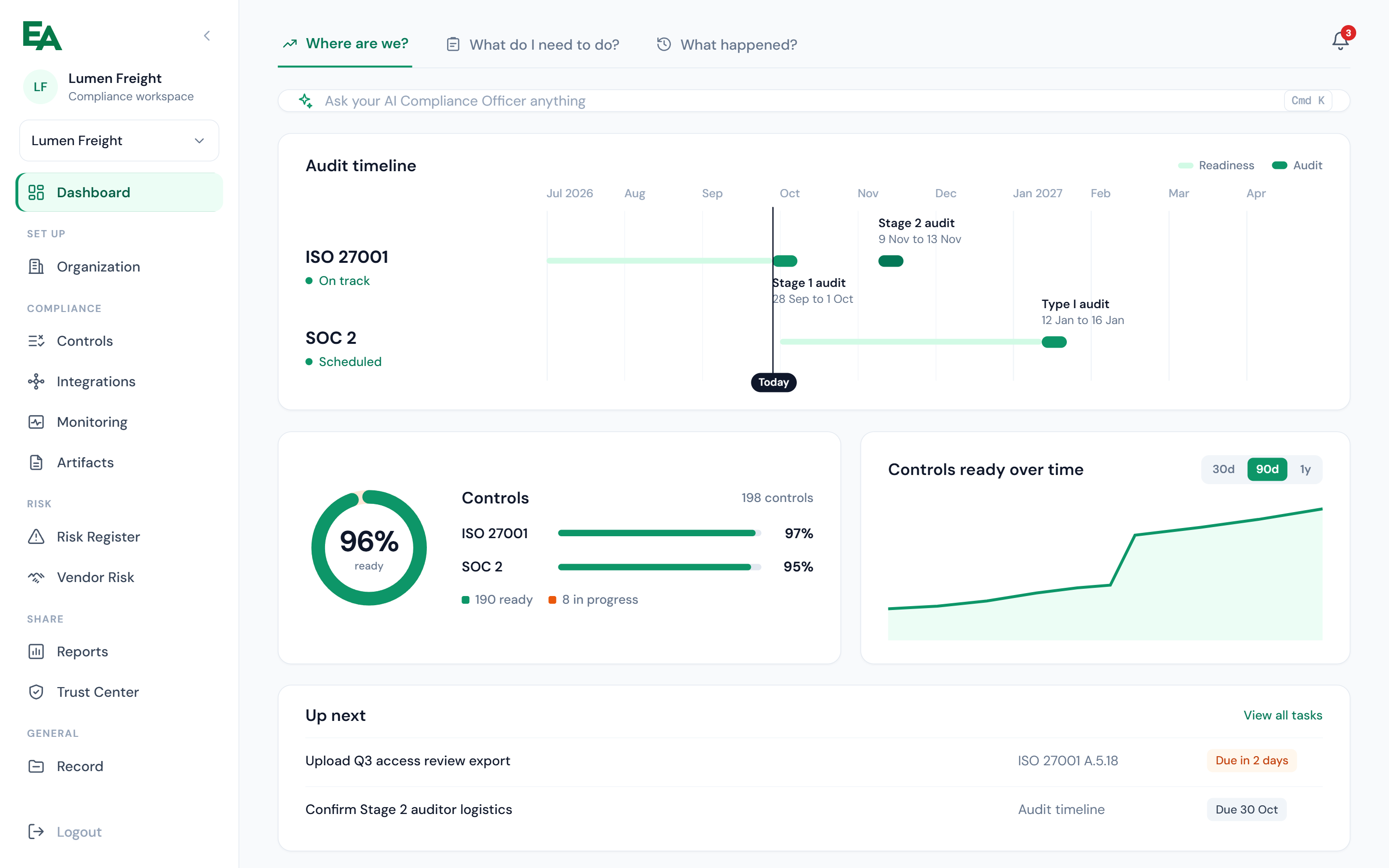
If a customer’s security review asks how you govern the AI in your product, a European tenant requires impact assessments before signing, or the board wants a named owner for systems making decisions about customers, the work can quickly fall to engineering, product, and legal teams already stretched across other priorities. We built this for you: regulated companies whose customers, regulators, insurers, or contracts demand evidence that AI is governed responsibly, whatever industry that pressure comes from.
Two things set us apart in this guide:
The AIMS is built on the control library you already run. ISO 42001 shares its clause structure with ISO 27001 and most of its security controls with SOC 2, so the management system, the internal audit, the management review, and the shared controls carry over, and only the AI-specific work is new. A free consultation with a Dedicated Compliance Expert covers what is already in place.
The audit-ready date is locked at signature, or you don’t pay. The accredited certification body schedules Stage 2 and remains the independent party that decides the certificate.
The 3 ISO 42001 Problems We Built EasyAudit to Solve
Problem 1: The impact assessments have no owner
ISO 42001's defining requirement is an AI system impact assessment for every system in scope: who it affects, how, what could go wrong, what you did about it, and when you’ll look again. It’s the control auditors check first and the one most often found as a blank template.
Engineering says it’s a governance task; legal says it’s a technical one; nobody owns it.
Our solution: We produce them. For each AI system in your inventory, our AI Compliance Officer drafts the impact assessment from how the system is actually built and used, with affected parties, identified impacts, treatment decisions, and reassessment triggers documented; your Dedicated Compliance Expert reviews it; your accountable owner approves it.
The same is done for the AI risk assessment and the Statement of Applicability against the 38 Annex A controls, with every inclusion and exclusion justified in writing for your signature.
Problem 2: The AIMS gets built as a second management system
Most organizations arriving at ISO 42001 already hold ISO 27001 or SOC 2. The clause structure is the same, the internal audit and management review are the same, and most of the security controls the AI systems depend on are already implemented and evidenced.
Most providers build the AIMS as a separate project anyway, with a second Statement of Applicability, a second evidence collection, and a second certification relationship.
Our solution: We run one control library that every framework maps into. The ISMS you hold is the management system the AIMS runs on; the SOC 2 and ISO 27001 controls that protect the AI infrastructure are reused; and only the 38 Annex A controls that are new get new work.
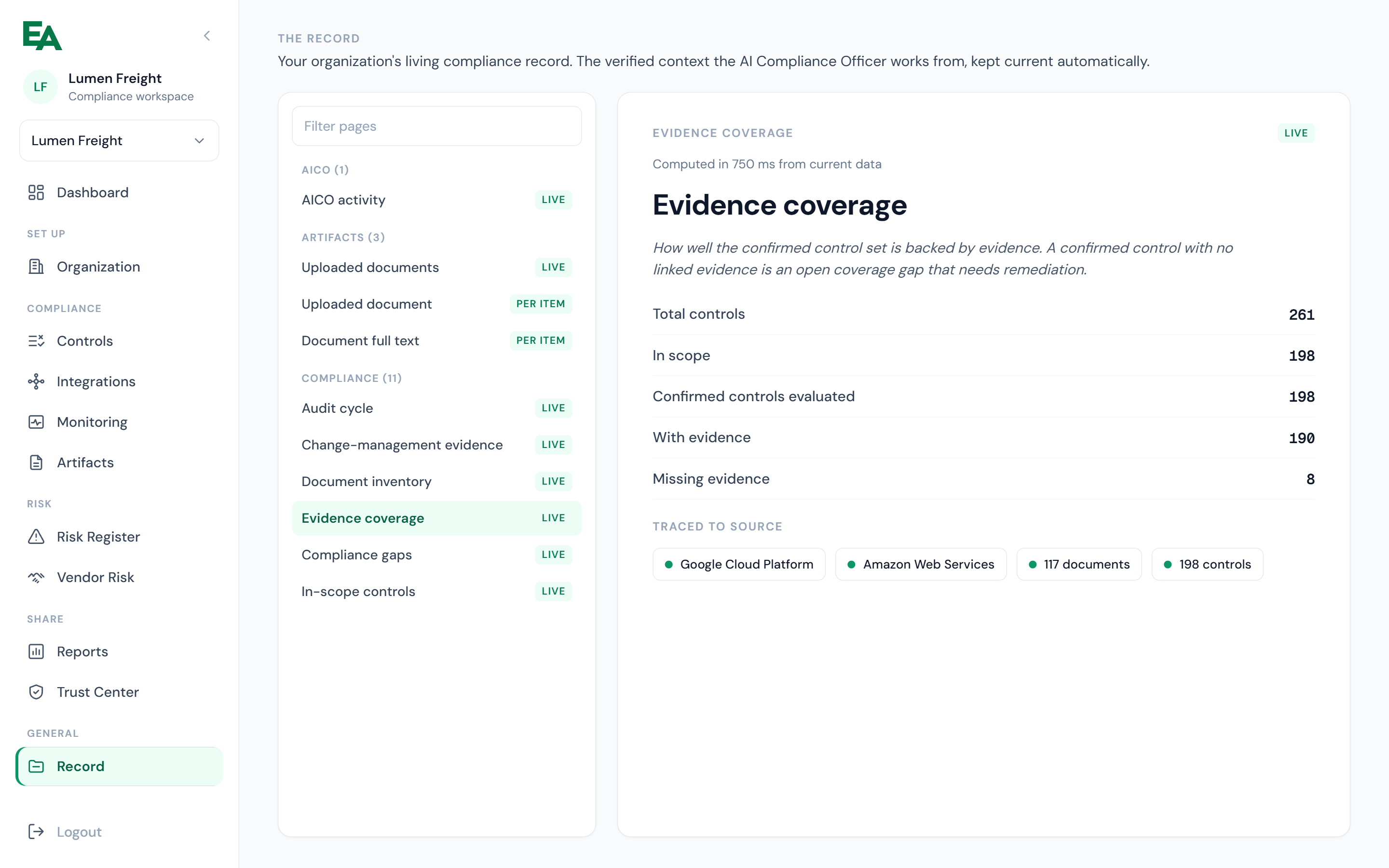
One control satisfies every subscribed framework that asks for it, one evidence set covers all mappings, and the program carries 60 to 70 percent fewer controls than managing frameworks separately. Add a framework. Do not add a person.
Problem 3: The models change faster than the certificate
An AI system that passed its impact assessment in March is retrained in June, repurposed in August, and connected to a new data source in October.
The standard requires reassessment when the system changes; the certificate describes the week of Stage 2. A workspace tracks the control; it doesn't notice the model moved.
Our solution: We keep the AIMS true. 3,950+ continuous monitoring checks run against the infrastructure and access controls the AI systems depend on; changes are detected, diagnosed, and prescribed; and reassessment triggers are tracked against the inventory so an impact assessment is revisited when the system changes rather than when the surveillance audit arrives.
Nothing stays correct on its own, and AI systems stay correct for less time than most.
Interactive Product Demo
Frameworks Covered
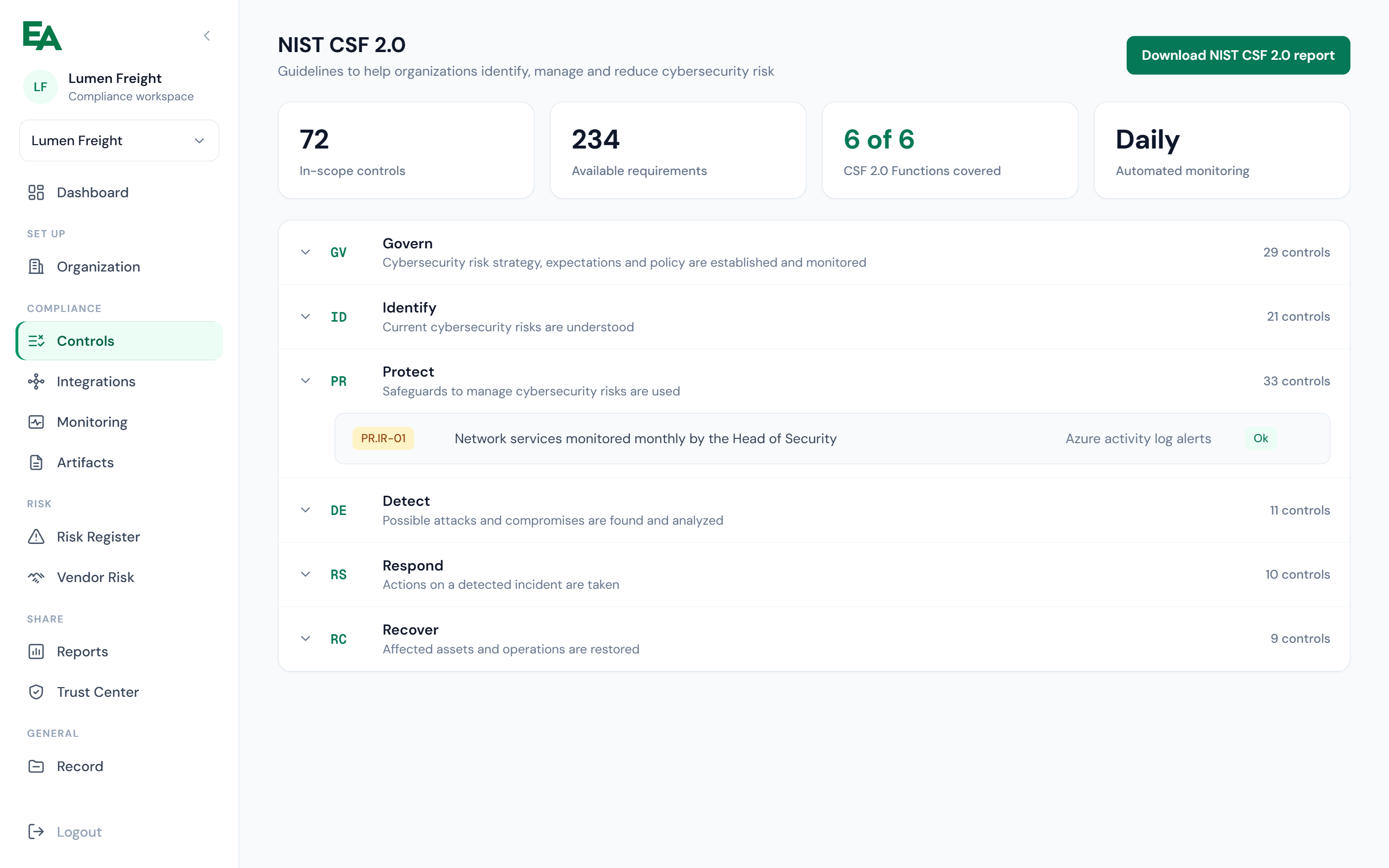
ISO 42001, ISO 27001, ISO 9001, SOC 1, SOC 2, and NIST CSF 2.0, on one control library. For the buyer on this page, the pairing that matters is ISO 42001 on top of ISO 27001 or SOC 2: the management system and the security controls are shared, and the AI-specific work is added to them.
One control satisfies every subscribed framework that asks for it, and the program carries 60 to 70 percent fewer controls than running them in parallel.
Who Does What the Standard Requires
The AI system inventory and your role for each system: documented from your environment and your product, approved by you.
The AI policy: written from your environment, reviewed and signed by your team.
The AI risk assessment and each AI system impact assessment: drafted by us with rationale, treatment, and reassessment triggers, approved by the accountable owner you name.
The Statement of Applicability against the 38 Annex A controls: drafted control by control with justifications, approved and signed by you.
The internal audit, performed independently of the people who did the work, and the management review your leadership holds: the engagement proposal states how both are staffed before you sign.
The accredited certification body then performs Stage 1 and Stage 2 and decides the certificate.
Pricing
The investment is fixed at signature, after a free consultation about your environment and the controls you already run.
For an organization adding ISO 42001 to an existing ISO 27001 or SOC 2 program, the consultation covers how much carries over. For a directional figure, use the cost calculator.
The comparison that holds is against what a second management system costs to build and keep: the implementation hours for the impact assessments and lifecycle controls, the consultant fees, the platform your team operates, and the internal time between surveillance audits.
Certification body fees remain separate, because an accredited body issues the certificate, and for ISO 42001 that body must be accredited for this standard.
We’re not the lowest-priced option in this guide, and we say so under Tradeoffs.
What Stays On Your Team
The approvals the standard reserves for the organization: the AI inventory and roles, the AI policy, each impact assessment, the Statement of Applicability, and the management review your leadership holds. Under ten hours a year in steady state, because the recurring AIMS work transfers to us instead of shrinking on your calendar.
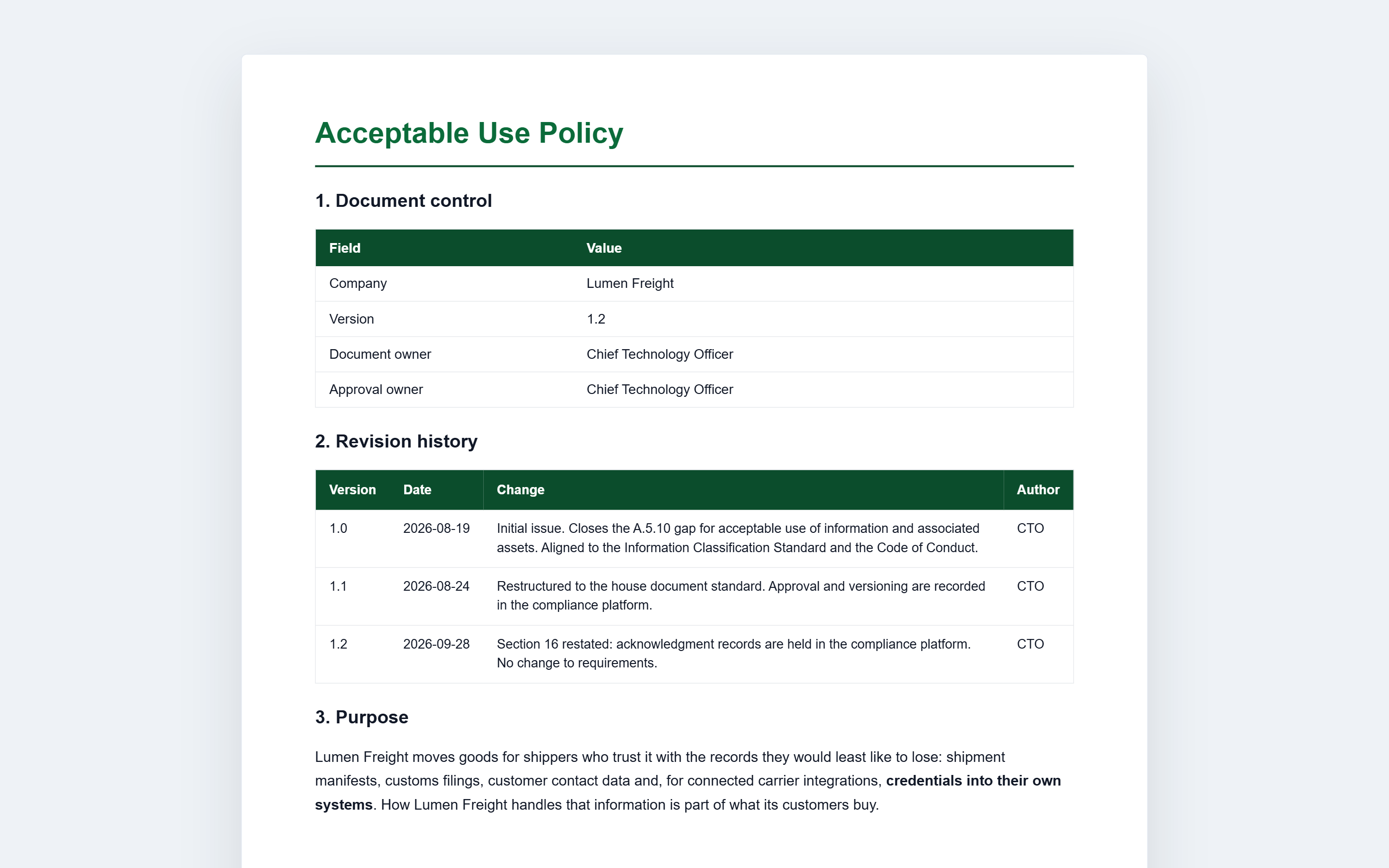
Controls are accepted in one click, with who approved and when recorded. A 15-minute meeting closes three to four evidence items. Signed-statement templates mean you never hit a dead end.
Setup
Setup starts with a free consultation. A Dedicated Compliance Expert asks which AI systems are in scope, your role for each, and what ISO 27001 or SOC 2 work you already have.
Tradeoffs
A GRC or AI governance team that wants to build and own its AIMS will be better served by a workspace and ISMS.online, Vanta, or Drata are built for exactly that.
A cloud-native AI startup pursuing a single certificate with no external pressure should look at Sprinto or Scytale's entry tier; we disqualify the smallest buyers at the booking form.
We’re not an accredited certification body and never issue the certificate; a buyer who wants readiness and certification from one accredited name will look at Coalfire and should ask how impartiality is maintained.
A procurement team that requires Schellman's or BSI's name on the certificate has a legitimate reason to go there.
We cost more than a software seat, and the guarantee covers readiness and submission by the committed date, not the certification body's decision.
Support
Your Dedicated Compliance Expert owns your AIMS end to end: sets the plan, checks every impact assessment and policy, deals with the certification body directly through Stage 1, Stage 2, and every surveillance audit. You never have to log in; you always can.
Mini Case Study: SOC 2 for an AI Company
TheStage AI builds an optimization and deployment engine for machine learning models, and its clients in automotive, healthcare, and finance hand it proprietary models, telemetry, and confidential IP.
Enterprise IT and legal teams required audited controls before committing, and competitors were positioning compliance as table stakes.
We scoped the controls, ran the risk assessment, generated the policies, collected the evidence, and coordinated the CPA firm for SOC 2, while the research team stayed on the product. This engagement was SOC 2, not ISO 42001.
The same control library is the foundation an ISO 42001 AIMS is built on, and an AI company is the buyer the standard was written for.
2. Scytale
Best for: a guided first AI management system: a workspace your team operates, with dedicated GRC experts beside it and a built-in audit path.
Compliance Service Score: 8.3/10
Scytale lists ISO 42001 alongside ISO 27001 and SOC 2 in its framework menu and pairs the workspace with in-house GRC experts who stay with the customer from scoping to the certification audit, which makes it the strongest guided option for a team building its first AI management system.
Product Overview
Evidence collection and continuous control monitoring across 100-plus integrations, user access reviews, vendor risk management, AI security questionnaires, and a Trust Center, with ISO 42001 controls mapped in the workspace.
Dedicated GRC experts interpret Annex A, review the impact assessments and policies your team produces, and coordinate audit logistics; a Built-In Audit option connects you to an audit partner through Scytale.
Pricing
Scytale's pricing page shows tiers without dollar figures.
Its AWS Marketplace listing, checked in July 2026, names starting SKUs: platform access from $7,500 per year for one framework, additional frameworks from $2,100, framework consulting from $4,000, a virtual compliance tier from roughly $36,000, and third-party audit services from $4,200.
ISO 42001 added to an existing framework is the additional-framework SKU plus the certification body's fees.
What Stays On Your Team
The AIMS itself. Your team inventories the AI systems, writes the AI policy and the impact assessments from templates, builds the Statement of Applicability, performs the remediation, and uploads evidence the integrations cannot reach.
Scytale's experts guide and review.
Setup
Sales-led, starting with a demo. Once connected, monitoring begins and the assigned expert scopes the program.
Time to Stage 2 depends on how fast your team completes the AI-specific work.
Tradeoffs
Scytale fits a smaller AI team doing its first certification with someone to call, and the deeper expert tier is a meaningful step up in cost.
If Scytale arranges your audit, confirm the body is accredited for ISO 42001 specifically and ask how impartiality between the guidance and the audit is documented.
3. Thoropass
Best for: buyers who want one vendor to run the workspace and coordinate the certification audit, with a Compliance Architect guiding the AIMS build.
Compliance Service Score: 7.9/10
Thoropass lists ISO 42001 among its frameworks and sells the workspace with audit coordination; for ISO standards, it cannot issue an accredited certificate and coordinates accredited partners for issuance, with a Compliance Architect guiding the AIMS build inside the platform.
Product Overview
Continuous monitoring, policy and procedure templates, evidence collection through integrations, and a dedicated Compliance Architect on the higher tiers, with ISO 42001 running alongside ISO 27001, SOC 1, SOC 2, HIPAA, HITRUST, PCI DSS, and CMMC.
Pricing
Not published.
Thoropass's AWS Marketplace listing shows a platform floor of roughly $8,700 per year, per UnderDefense's July 2026 pricing guide, with observed contracts averaging about $30,000 and external ISO certification-body fees cited separately at roughly EUR 8,000 to 30,000.
What Stays On Your Team
The AIMS. Your team builds the inventory, the impact assessments, and the Statement of Applicability, performs the remediation, and uploads evidence outside the integrations.
The Compliance Architect advises on what the certification body will expect.
Setup
Sales-led, with a demo and scoping call before contract.
The Compliance Architect sets the readiness plan once the platform is live.
Tradeoffs
Thoropass is the pick if you value one vendor for the workspace and the audit logistics and are comfortable that the certificate comes from a partner body it coordinates.
Ask which accredited body that is, confirm its ISO 42001 accreditation, and ask who owns the surveillance relationship in years two and three.
4. Coalfire
Best for: organizations certifying to ISO 42001 together with other ISO standards, with a mock audit by certification body staff before Stage 2.
Compliance Service Score: 7.5/10
Coalfire Certification holds ANAB accreditation for ISO 42001 alongside ISO 27001 and a long list of companion standards, which makes it the body to consider when ISO 42001 is one of several ISO certificates being pursued at once.
A lead auditor facilitates readiness and offers a mock audit by certification body staff before Stage 2.
Service Overview
Assessors audit against ISO 42001, 27001, 27017, 27018, 27701, 9001, 20000-1, 22301, and CSA STAR in any combination.
Readiness assessment and mock audit precede Stage 1 and Stage 2, and Compliance Essentials coordinates evidence across 80-plus frameworks so shared controls are reused.
Pricing
Not published, scoped by engagement; Coalfire publishes no rates.
Ask for the readiness assessment, the mock audit, and the three-year lifecycle priced separately.
What Stays On Your Team
Building and running the AIMS between assessments.
Coalfire documents gaps and rehearses; the customer implements, and the certifying arm cannot close the gaps it finds.
Setup
Sales-led scoping, then readiness, mock audit, Stage 1 and Stage 2.
Tradeoffs
Coalfire's breadth across ISO standards under one accredited body, plus a mock audit from the people who’ll run the real one, is the case for choosing it.
The model is assessment and certification, not execution, and for a mid-market company the depth may cost more than needed.
5. Schellman
Best for: organizations that want the certifier with the most ISO 42001 certificates issued, and concurrent ISO 27001 or SOC 2 from the same firm.
Compliance Service Score: 7.4/10
Schellman became the first ANAB-accredited ISO 42001 certification body on September 24, 2024, holds UKAS accreditation, and by October 2026 has issued more ISO 42001 certificates than any other disclosed certifier, about a third of the market, including AWS and KPMG International.
It separates readiness (Schellman Compliance) from certification (Schellman & Company) by corporate structure.
Service Overview
Schellman performs Stage 1 and Stage 2 for ISO 42001, issues the certificate, conducts surveillance audits throughout the cycle, and can run ISO 27001 and SOC 2 concurrently under one team.
Readiness through the non-attest entity identifies gaps and recommends remediation. Schellman sells no platform and works with the major ones.
Pricing
Not published, scoped to the AIMS boundary and the number of AI systems in scope. Schellman publishes no rates; one third-party guide places ISO 42001 certification at roughly $20,000 to $40,000.
Ask for the full three-year cycle priced up front.
What Stays On Your Team
All of it. Schellman assesses readiness and certifies; it doesn’t inventory your systems, write the impact assessments, or build the Statement of Applicability. That work is yours or a separate provider's.
Setup
Engagements are scheduled in advance, with Q4 and Q1 peak planning. A readiness assessment precedes Stage 1.
Tradeoffs
Schellman is the certifier to shortlist when the name on the certificate matters to enterprise customers, when ISO 27001 or SOC 2 run concurrently, and when experience with the standard is the deciding factor.
It’s not a readiness service in the performing sense; there’s no committed readiness date, and the assessment fee buys advice.
6. Vanta
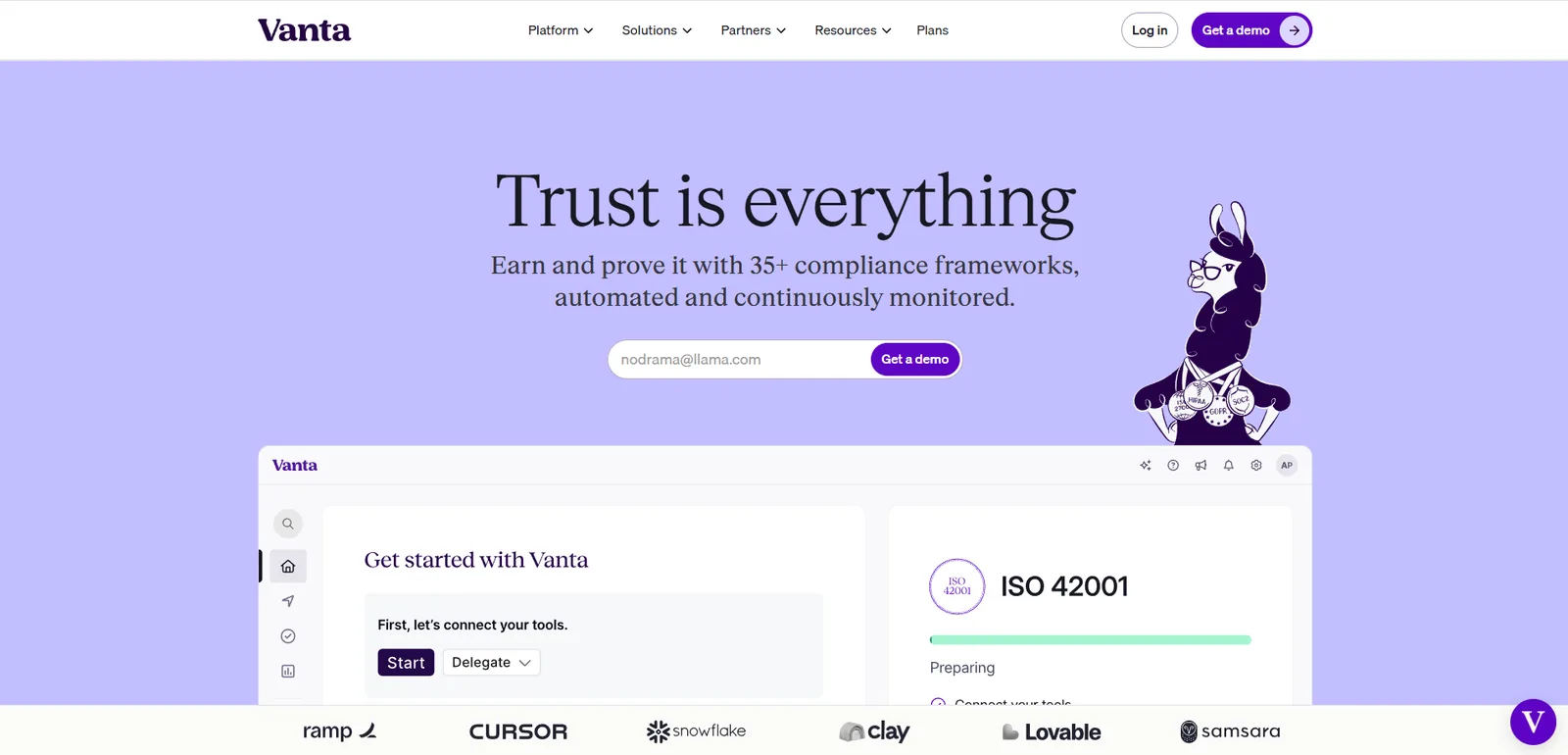
Best for: in-house GRC teams that want a broad compliance workspace with ISO 42001 and the NIST AI RMF as frameworks among many.
Compliance Service Score: 7.0/10
Vanta supports ISO 42001 and the NIST AI Risk Management Framework as frameworks in one of the most widely adopted compliance workspaces in the category, with thousands of customers by its own count and the largest auditor and partner network.
The AIMS is built and run by your team inside it.
Product Overview
Plans are Essentials, Plus, Professional, and Enterprise, with policy generation, automated evidence collection, continuous controls monitoring, a Trust Center, and an auditor network.
Higher tiers add access management, questionnaire automation, risk management and custom tests, and Vanta's AI agent drafts policies and proposes remediation for failing tests.
Pricing
Vanta's own pricing page offers personalized quotes only.
Its AWS Marketplace listing prices a 12-month contract for 1 to 20 employees at $14,000 for Essentials, $21,500 for Plus, and $23,000 for Professional, per SOC2Auditors.org (August 2026).
Each framework is priced separately, so ISO 42001 is an incremental line. Certification body fees are separate.
What Stays On Your Team
Everything the standard requires: the AI inventory, the impact assessments, the Statement of Applicability, the policies, remediation, and certification body management.
Setup
Integrations connect quickly for cloud-native stacks; monitoring begins once live.
Tradeoffs
Vanta fits a GRC team that will build the AIMS itself and already runs SOC 2 or ISO 27001 on the platform.
It’s a poor fit for a company with nobody to operate it, and for models running in Microsoft-heavy or on-prem estates the integration library assumes away.
No outcome guarantee is offered.
7. Drata
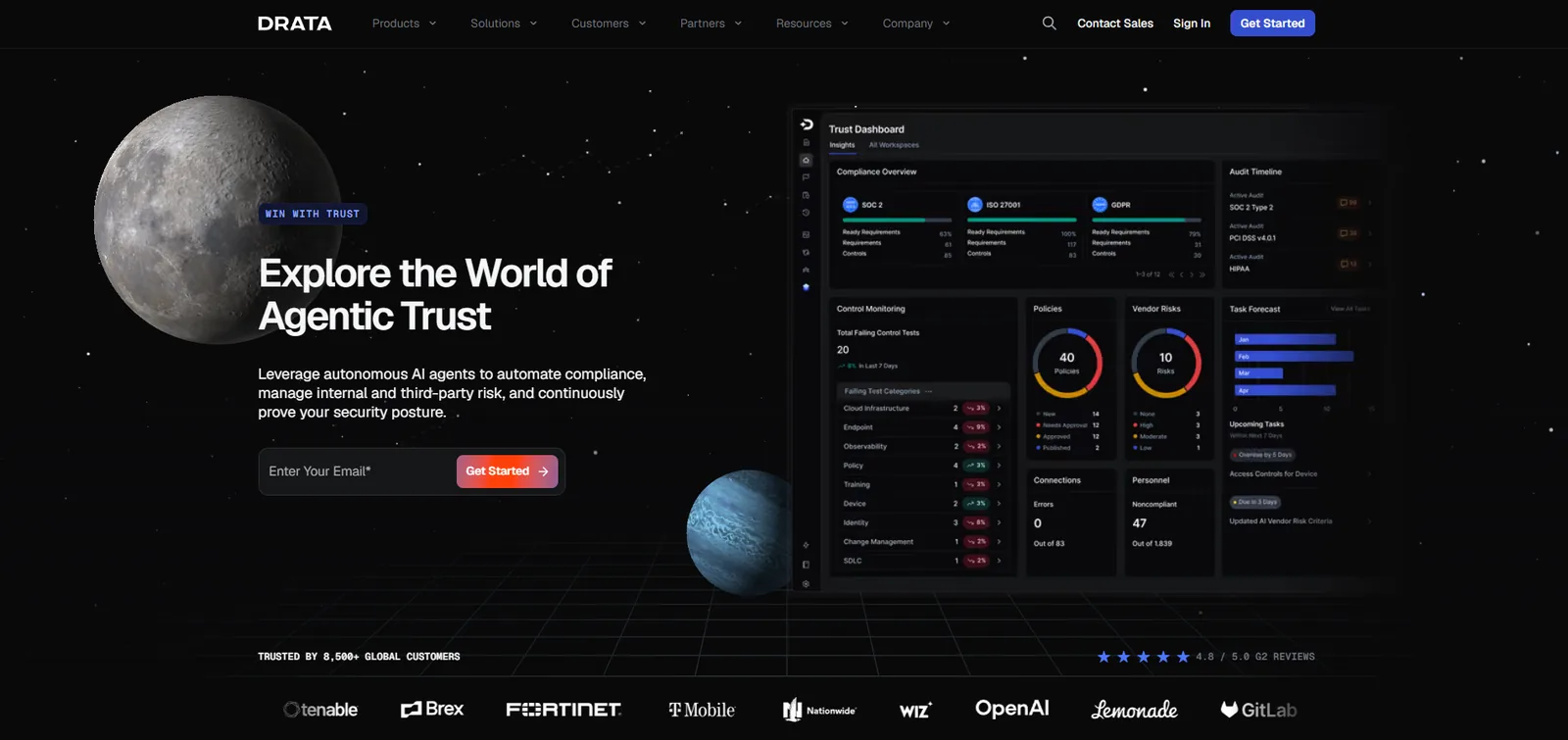
Best for: engineering-led AI teams that want to run ISO 42001 alongside SOC 2 and ISO 27001 as code on one platform.
Compliance Service Score: 6.9/10
Drata publishes an ISO 42001 framework overview in its help center that describes AI-specific risk management tracking, a policy library aligned to the standard, real-time monitoring of AI-specific controls and Trust Center disclosure of AI governance.
The AIMS is built and run by the customer, alongside SOC 2 and ISO 27001 on one platform.
Product Overview
Plans are Foundation, Essential, Advanced and Enterprise.
The platform monitors controls continuously, maps evidence across frameworks, provides a policy center and gives certification auditors a dedicated workspace; the Drata Trust Center can publicly disclose ISO 42001 governance details.
Pricing
Not published, with no free tier and a one-year minimum commitment.
Reported medians differ by dataset: Orbiq cites a Vendr median of about $24,600 per year across 222 tracked purchases; UnderDefense cites a median near $38,000 across 94 verified purchases.
Per-framework fees and certification body fees sit outside the platform number.
What Stays On Your Team
Everything: the AIMS is built and run by your team. Drata monitors and reports.
Setup
Cloud, identity and HR systems connect through the integration library.
Tradeoffs
Drata is a strong choice for an engineering-led AI company that wants to run ISO 42001 as code beside SOC 2 and ISO 27001.
It’s quote-gated at every tier, carries hidden costs third-party analysts estimate at 20 to 81 percent over the base license, and offers no committed date.
8. ISMS.online
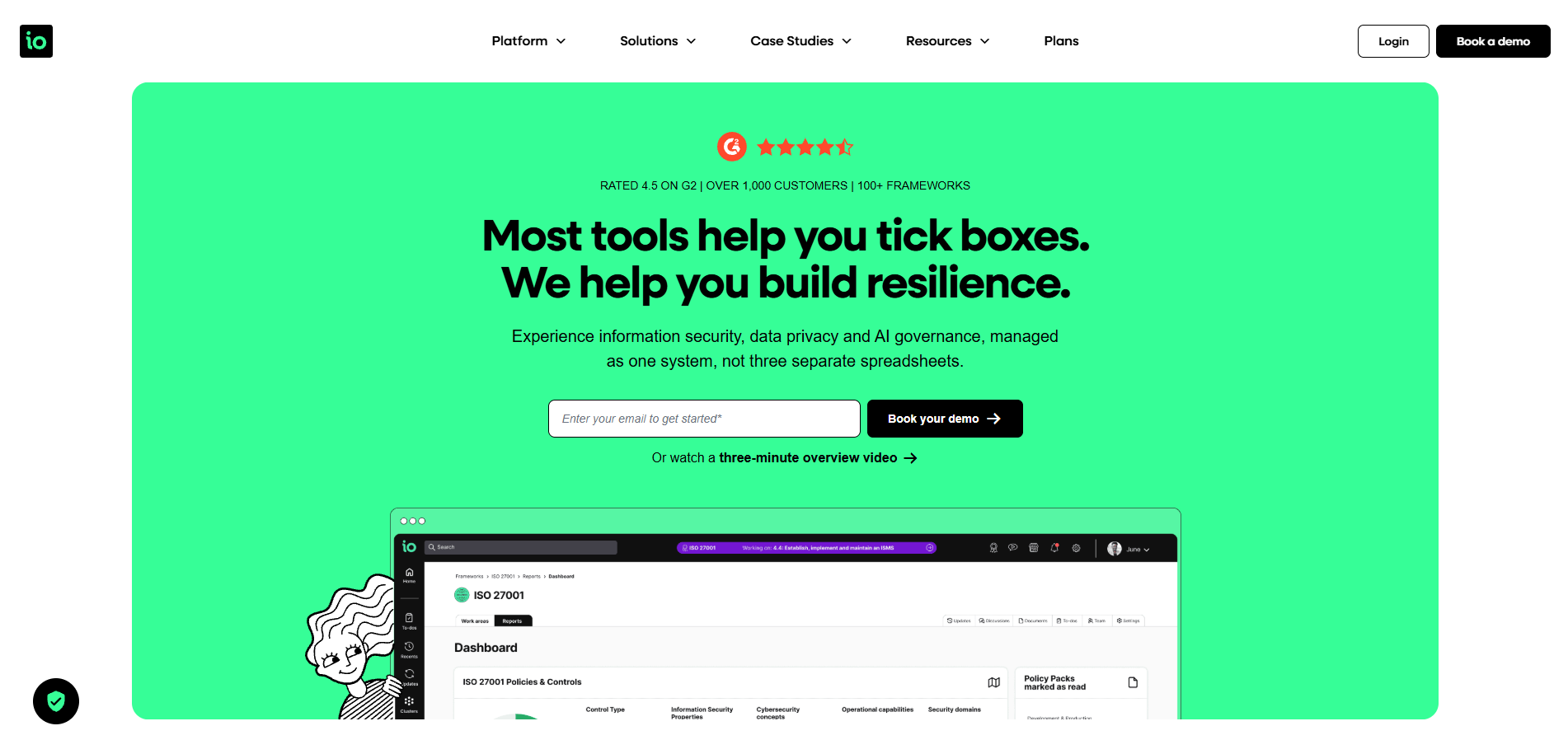
Best for: teams that will build the AIMS themselves and want a workspace organized around the standard, with a method and a coach.
Compliance Service Score: 6.8/10
ISMS.online supports ISO 42001 as a dedicated AI management system inside its workspace, with its own pages mapping the Annex A controls, AI policy management and impact assessment documentation, guided by the Assured Results Method, a Virtual Coach and an in-house expert team.
Product Overview
The platform organizes the AIMS the way the standard does: AI policy, roles, resources, impact assessments, lifecycle controls, data governance, transparency and third parties, with the method walking a team through each step and consolidating audits across ISO 42001, ISO 27001 and ISO 27701 in one place.
More than 100 standards are supported.
Pricing
Bespoke quotes across three packages tiered by company size and compliance experience; ISMS.online publishes tiers without dollar figures.
Ask what adding ISO 42001 to an existing ISO 27001 subscription costs and how expert guidance hours are bounded.
What Stays On Your Team
Building and running the AIMS by following the method. The coach and the expert team tell your team what to do and review what it did; the inventory, the impact assessments, and the Statement of Applicability are yours to produce.
Setup
Onboarding led by a customer success manager, with live chat and the Virtual Coach inside the platform.
Tradeoffs
ISMS.online is the best pure AIMS workspace for a team that wants to build its own system with the standard as the map, particularly one already running ISO 27001 there.
It’s still a workspace: the work is yours, there’s no committed date, and the certification body is your own.
9. BSI
Best for: organizations whose customers or regulators in the UK and EU expect UKAS- or RvA-accredited certification on the certificate.
Compliance Service Score: 6.8/10
BSI holds the broadest accreditation footprint for ISO 42001 on this list: RvA in December 2024, the first UKAS accreditation in January 2026, and ANAB in March 2026.
For a buyer whose customers or regulators sit in the UK or EU, that triple accreditation is the reason to shortlist it.
Service Overview
BSI Assurance performs Stage 1, Stage 2, and the surveillance and recertification audits across ISO 42001, ISO 27001, ISO 27701, ISO 22301, and ISO 9001.
BSI's separate consulting practice offers management system implementation and internal audits, kept apart from the certifying arm so the body never advises on what it certifies.
Pricing
Not published for both practices. BSI publishes no rates; a third-party auditor directory cites roughly GBP 25,000 to 150,000 for ISO 42001 certification by scope.
Ask for the three-year cycle from the certifying arm and, separately, the consulting scope if you want implementation help.
What Stays On Your Team
With BSI Assurance alone, everything but the audit.
With BSI Consulting engaged as well, implementation can be scoped, staffed separately to protect impartiality.
Setup
Certification-led scheduling against your declared readiness; consulting engagements are scoped separately and precede the audit.
Tradeoffs
BSI is the right choice when the accreditation on the certificate matters to UK and EU customers and you either have an AIMS or will build one with a separate provider.
The certifying arm cannot close gaps, the consulting arm is a separate engagement, and no readiness date is committed.
10. Sprinto
Best for: cloud-native AI startups on a budget that will build the AIMS themselves, priced on headcount rather than seats.
Compliance Service Score: 6.5/10
Sprinto supports ISO 42001 in a compliance workspace built for cloud-hosted companies, priced on total headcount with unlimited users, and publishes its own guide to the 38 Annex A controls.
It’s frequently the lowest-cost platform for a startup adding AI governance to SOC 2.
Product Overview
Automated evidence collection, continuous monitoring, built-in policy templates, an auditor dashboard and a support team, with risk, vendor, asset and endpoint modules as priced add-ons, and ISO 42001 alongside ISO 27001, SOC 2, HIPAA, GDPR and PCI DSS.
Pricing
Sprinto's pricing page is gated.
Vendr data from seven verified purchases puts the median contract at about $15,000 per year, ranging from $11,500 to $19,300, with third-party guides describing tier bands from roughly $6,000 to $25,000.
Each additional framework adds an estimated $3,000 to $8,000 per year. Certification body fees are separate.
What Stays On Your Team
Everything the standard requires. Your team builds the AIMS from templates, runs the impact assessments, closes every failing check, and collects evidence outside the integrations.
Setup
Integrations for cloud-native stacks connect early; monitoring begins once live.
Tradeoffs
Sprinto is the rational choice for a cloud-native AI startup with a budget that will build its own AIMS.
Its published limitations include no confirmed SCIM at any tier, no native DLP or DSPM tooling, and one verified G2 reviewer in July 2026 cited missing Microsoft Sentinel and Defender for Cloud integrations.
For a regulated company with on-prem inference or physical operations, integration coverage is the first thing to test.
11. SGS
Best for: multinationals that want ISO 42001 certified by a global inspection and certification company with audit teams in every region they operate.
Compliance Service Score: 6.5/10
SGS, the world's largest inspection, verification, and certification company, has been ANAB-accredited for ISO 42001 since 2025 and, by October 2026, accounts for about one in nine ISO 42001 certificates where the certifier is disclosed.
For a multinational that wants one certifier across regions, it’s the body built for that.
Service Overview
SGS performs Stage 1, Stage 2, and the surveillance and recertification audits for ISO 42001 alongside its management system certification across ISO 27001, ISO 9001, and the wider ISO family, with audit teams in the regions multinationals operate.
Pricing
Not published, scoped by engagement. SGS publishes no rates. Ask for the full three-year cycle and for how multi-site or multi-region scopes are priced.
What Stays On Your Team
All of it. SGS certifies; the AIMS, the impact assessments, and the evidence are yours to build and run.
Setup
Certification-led scheduling against your declared readiness.
Tradeoffs
SGS is the right choice for a multinational that wants a single global certifier.
It’s a certification body, not a readiness service: it cannot help build the AIMS it certifies, the published detail on its ISO 42001 practice is thinner than Schellman's or BSI's, and no readiness date is committed.
How We Built This Guide
We started with the standard and the market. ISO 42001 names work no other framework asks for, the AI system impact assessment above all, and only bodies accredited for this specific standard can certify it.
So every provider was assessed on which of the standard's requirements it performs, guides or leaves with the customer, and every certifier's ISO 42001 accreditation was checked against the body's own announcement and the accreditor's record rather than assumed from an ISO 27001 scope.
We read each provider's own service pages, help documentation, pricing pages and accreditation announcements in October 2026, used the published certification data from iso42k.com for market share where the certifier is disclosed, and used third-party transaction datasets and directories only for observed pricing ranges, attributed inline.
Where a claim couldn’t be sourced to the provider's own material or a named source, we left it out or turned it into a question for you to ask. Secureframe, which supports ISO 42001 by third-party accounts, isn’t on this page because we couldn’t confirm it from Secureframe's own ISO 42001 material in this pass.
EasyAudit was scored on the same seven criteria and weights as every other provider, and every provider carries the same scores on every page of this series.
How to Choose an ISO 42001 Compliance Service
Six steps, each specific enough to run this week.
Step 1: Inventory Your AI Systems and Your Role for Each
Write down every AI system in scope and whether you develop it, provide it, deploy it or use it: your own models, the vendor AI embedded in your product, the third-party services your staff rely on.
The standard's requirements differ by role, the scope of your certificate is the scope of this list, and a provider that does not ask for it in the first conversation is not ready to quote.
Step 2: Ask Who Produces the Impact Assessments
For each system, someone has to document who it affects, how, what could go wrong, what was done about it and when it will be reassessed.
Ask each provider, system by system, whether it produces the impact assessment, guides your team to produce it, or supplies a template.
This is the requirement most often found blank at Stage 1 and the one that separates a service from a workspace.
Step 3: Decide What Carries Over From Your ISMS or SOC 2 Program
If you hold ISO 27001 or SOC 2, most of the management system and most of the security controls the AI depends on already exist.
Ask each provider what percentage of your existing controls, evidence, internal audit, and management review the AIMS reuses, and whether ISO 42001 is a second Statement of Applicability and a second evidence collection or a new mapping of the same library.
If the provider cannot answer, it’s a second project.
Step 4: Confirm the Certifier Is Accredited for ISO 42001 Specifically
An ISO 27001 accreditation doesn’t authorize ISO 42001 certification.
Ask which body will certify you and check its ISO 42001 scope on the accreditor's record: ANAB, UKAS, RvA, or another IAF member.
Then ask the impartiality question: a body that helped build your AIMS cannot certify it, so a provider offering both must separate them and document how.
A provider that builds the AIMS and never certifies it has removed the question.
Step 5: Price the Three-Year Cycle and the Reassessments
Stage 1 and Stage 2 in year one, a surveillance audit in each of the next two years, recertification before the certificate expires, and the service or platform fee for all three years.
Then ask what happens when a model is retrained or repurposed mid-cycle: who reassesses it, and is that in the price.
AI systems change faster than certificates, and the reassessment work is where the second-year cost hides.
Step 6: Put the Audit-Ready Date and the Consequence in Writing
Ask for a committed readiness date in the contract and what happens if it’s missed.
Workspaces are paid whether you reach Stage 2 or not. Consultancies bill by scope whether you certify or not. Certification bodies audit when you say you’re ready.
The one provider in this comparison that locks the date at signature and forgoes its fee if the date slips is EasyAudit, and the boundary is stated beside it: the guarantee covers readiness and submission, and the accredited certification body decides the certificate.
ISO 42001 Compliance Services Pricing and Costs in 2026
Three cost models appear among ISO 42001 compliance providers, and every one of them sits on top of the certification body's fees across the three-year cycle unless the provider is itself the accredited body.
The number to ask about first isn’t the audit fee; it’s what adding ISO 42001 to the program you already run costs.
Workspace subscriptions, mostly quote-only. Vanta, Drata, Sprinto, Scytale, Thoropass, and ISMS.online publish entry SKUs on marketplaces, package tiers without figures, or nothing.
Observed contracts for the general compliance workspaces run from about $7,500 to more than $100,000 a year depending on headcount and framework count, with Vendr medians between roughly $15,000 (Sprinto) and $20,000 to $38,000 (Vanta, Drata).
ISO 42001 is an additional framework at an incremental fee: Scytale lists additional frameworks from $2,100, and third-party guides put increments at other platforms between $3,000 and $8,000 a year.
The impact assessments and the AIMS build are your team's time in every one of these models.
Accredited bodies billing by scope. Schellman, Coalfire, BSI and SGS scope readiness or pre-assessment separately from the certification audits and publish no rates.
Third-party guides and directories cite ISO 42001 certification at roughly $20,000 to $40,000 (Schellman) and GBP 25,000 to 150,000 by scope (BSI), with Stage 1, Stage 2, two surveillance audits and recertification across three years.
Impartiality rules keep the fixing out of scope, so it’s billed by a separate provider or done by your team.
Outcome-priced service. EasyAudit starts with a free consultation, then fixes the investment and the audit-ready date at signature, with its fee at risk if the date is missed. The certification body's fees remain separate, because an accredited body issues the certificate.
The questions ISO 42001 buyers ask about price, answered
"We already hold ISO 27001. Is ISO 42001 a whole new program?"
With most providers, yes in practice: a second Statement of Applicability and a second evidence collection, even though the clause structure and most security controls are shared.
On one control library it’s the AI-specific work added to the system you already run, and the consultation covers how much carries over.
"How long will it take and how much will it cost?"
Both are fixed at signature, after a free consultation about your environment. The audit-ready date is committed, and our fee is behind it.
"Our enterprise customers want the certificate from a name they know."
Schellman, BSI and SGS are the certifiers most often named, and every accredited body on this page is available to you whichever readiness path you choose.
A readiness provider that never certifies leaves the choice of body entirely yours.
"What does it cost when the model changes?"
Ask every provider. The standard requires reassessment after retraining or repurposing, and in most engagements it becomes new scope or your team's time.
In EasyAudit's program, reassessment triggers are tracked against the inventory as part of the service.
"We tried to build the AIMS in a tool, and the impact assessments stalled."
That’s the most common ISO 42001 story so far, and it’s the model working as designed. The consultation is free, and if you proceed, the building transfers to us.
ISO 42001 Compliance Services Pricing Comparison
Provider | Starting Price | Model | Dedicated Compliance Expertleads | Impactassessmentswritten for you | Continuousmonitoring | Committedaudit-readydate | Freereadinessassessment |
EasyAudit | Fixed at signature after a free consultation | Outcome-pricedservice | ✓ | ✓ | ✓ | ✓ | ✓ |
Scytale | From $7,500 per year (AWS SKU); additionalframeworksfrom $2,100 | Subscriptionplus consulting tiers | Add-on | No | ✓ | No | No |
Thoropass | About $8,700 platform per year (AWS) | Subscriptionplus auditcoordination | Add-on | No | ✓ | No | No |
Coalfire | Not published | Accredited body plus platform | No | No | Add-on | No | No |
Schellman | Not published; third-partyguide about $20,000 to $40,000 | Accredited body, scoped engagement | No | No | No | No | No |
Vanta | From $14,000 per year (AWS, 1 to 20 employees) | Subscription | No | No | ✓ | No | No |
Drata | Vendr median about $24,600 to $38,000 per year | Subscription | No | No | ✓ | No | No |
ISMS.online | Not published; three packages, quoted | Subscriptionplus method and coaching | Add-on | No | No | No | No |
BSI | Not published; directory cites GBP 25,000 to 150,000 | Accredited body; separateconsulting | Add-on | Add-on | No | No | No |
Sprinto | Vendr median about $15,000 per year | Subscription | No | No | ✓ | No | No |
SGS | Not published | Accredited body, scoped engagement | No | No | No | No | No |
Pricing as of October 2026, sourced from public marketplace listings, published plans, third-party datasets, and auditor directories as attributed in each entry. "No" means the provider does not offer it; "Add-on" means the capability is available at a priced tier, through a separate practice, or through a partner. Certification body fees are additional in every model except where the provider is the accredited body, and that body must hold ISO 42001 accreditation specifically. Contact each provider directly for current terms.
Questions to Ask Before You Choose an ISO 42001 Compliance Provider
Six questions. Ask every provider the same six, including us, and compare the answers side by side.
Question 1: Who produces the AI system impact assessment for each system in scope?
Produce, guide or template. Document by document, in writing.
Question 2: What carries over from our ISO 27001 or SOC 2 program?
Controls, evidence, internal audit and management review, as a percentage, and whether the Statement of Applicability is one or two.
Question 3: Is the certifier accredited for ISO 42001 specifically, and did you also help build the AIMS?
Show us the accreditor record. If yes to both, show us the impartiality documentation.
Question 4: What happens when a model is retrained or repurposed mid-cycle?
Who notices, who reassesses, and is it in the price.
Question 5: What does the full three-year cycle cost, including reassessments?
Stage 1, Stage 2, both surveillance audits, recertification, and the year-two and year-three fee, in the contract.
Question 6: What happens if the audit-ready date is missed?
If there’s no committed date, that’s the answer. If there is, what does the provider forfeit?
What to Verify Before You Sign
ISO 42001 programs fail at Stage 1, when the auditor opens the impact assessments.
The buyer discovers that the templates were never completed, that the AI inventory stopped at the models the data team knew about and missed the vendor AI in the product, or that the certifier's accreditation covers ISO 27001 but not this standard.
Verification is how you find those problems while you can still walk away.
Critical checks:
A description, in writing, of the AI system impact assessment and the Statement of Applicability against Annex A that the provider will produce for you, and who approves each.
The certifier's ISO 42001 scope on the accreditor's record (ANAB, UKAS or RvA), and the impartiality conclusion in writing from any provider that both builds and certifies.
Named owners, on the provider's side or yours, for the AI inventory, each impact assessment, the AI policy, the internal audit, and the management review, in writing.
The reassessment mechanism: what triggers a new impact assessment when a model changes, and who’s accountable for noticing.
The audit trail: approvals show who and when, the trail is enforced below the application layer so it cannot be bypassed, and impact assessment records are retained for the full cycle. Database-level trails with 7-year retention exist in this category; ask for the equivalent.
The year-two and year-three price, the fee for adding the framework, the surveillance audit fees, and the exit terms, in the contract, not the deck.
Name specific systems to test during evaluation: every production model and its retraining pipeline, the vendor AI embedded in your product, the AI services your staff use, the identity provider and endpoint manager that gate access to them, the cloud accounts the models run in, and the data stores they train on.
Ask for evidence collected from each one during evaluation, not from a demo environment.
Key Capabilities to Look for in an ISO 42001 Compliance Service
Choosing an ISO 42001 compliance service means looking beyond templates and gap assessments to the work the provider actually takes off your team, how it integrates AI governance with existing management systems, and whether it commits to a measurable path to audit readiness.
1. AI System Impact Assessments Produced, Not Templated
If the impact assessment arrives as a form for your team to fill in, the standard's defining requirement is still ahead of you.
Look for a provider that drafts each assessment from how the system is actually built and used, with affected parties, impacts, treatment, and reassessment triggers documented for your accountable owner to approve.
Ask for a written description of what it will produce for a system like yours.
2. One Control Library Under the ISMS and the AIMS
If ISO 42001 arrives as a second Statement of Applicability and a second evidence collection, you’re rebuilding the management system you already have.
Look for one library that ISO 27001, SOC 2, and ISO 42001 all map into, so the shared controls are implemented once and only the 38 Annex A controls that are new get new work. Ask what carries over; across the security frameworks, EasyAudit's program carries 60 to 70 percent fewer controls than managing them separately.
3. A Living AI Inventory With Reassessment Triggers
If the inventory is a spreadsheet from the scoping call, it’s wrong by Stage 2.
Look for an inventory that records each system's role, owner and last assessment, and a mechanism that flags retraining, repurposing, and new data sources for reassessment rather than waiting for the surveillance audit.
4. Continuous Monitoring of the Controls the AI Depends On
If the access, change and data controls around your models are checked once a year, the AIMS describes last March.
Look for monitoring that checks those controls daily against your connected systems, detects drift the day it appears, and feeds the risk register and the policies. A yearly surveillance audit cannot detect a Tuesday.
5. A Certifier Accredited for This Standard, Chosen on Its Merits
If your certifier's accreditation covers ISO 27001 only, the certificate isn’t accredited for ISO 42001.
Look for a readiness provider that never certifies, so you choose among Schellman, BSI, Coalfire or SGS on their merits with no impartiality question attached, and check the ISO 42001 scope on the accreditor's record before you book Stage 1.
6. A Committed Audit-Ready Date With a Consequence
If the provider's fee is safe whether or not you reach Stage 2 on time, the timeline is a hope.
Look for an audit-ready date locked at signature and a stated consequence if it’s missed, with the boundary beside it: no provider can promise the certificate, and any that claims to should be questioned.
Which ISO 42001 Compliance Service Is Right for Your Organization?
If you have a GRC or AI governance team that will build and run the AIMS itself, choose the workspace that fits your stack and your existing program: ISMS.online if you already run ISO 27001 there; Vanta or Drata if SOC 2 and ISO 27001 are on the same platform; Sprinto if budget is the constraint and you are cloud-native; Scytale if you want an expert bench inside the subscription.
If you have an AIMS and need the certificate, choose the accredited body your customers will recognize: Schellman for the most ISO 42001 experience and concurrent SOC 2 or ISO 27001; BSI for UKAS and RvA accreditation in the UK and EU; Coalfire when several ISO standards certify at once; SGS for a single global certifier.
If a customer, a tenant, or the board is waiting on the certificate, you already hold ISO 27001 or SOC 2, nobody internal is going to inventory the systems and write the impact assessments, and your models run in a Microsoft, on-prem, or regulated estate, choose the provider that builds the AIMS on the controls you already have and puts its fee behind an audit-ready date. That’s EasyAudit. Request a Demo and decide for yourself.
Is EasyAudit Worth Its Cost?
Against a workspace seat, no, if your team will build and run the AIMS and you have an AI governance function with time to write the impact assessments. A workspace at a few thousand to a few tens of thousands of dollars a year is the rational purchase for that organization.
Against what a certified AI management system costs a regulated company over three years, the comparison changes. Add the hours to inventory the systems and write an impact assessment for each. Add the consultant hired when the assessments stall at Stage 1.
Add the second Statement of Applicability and the second evidence collection built because the provider did not map to the ISMS you hold. Add two surveillance audits and a recertification, each preceded by a scramble to reassess the models that changed, and the customer that waits while it happens.
Consultants and human-centric tools cost 10 to 100 times more manual hours than Autonomous Compliance, and none of them puts your audit-ready date at risk.
EasyAudit is the right purchase when you want a certified, maintained AI management system built on what you already have, and you want to stop building it.
A free consultation with a Dedicated Compliance Expert is how you check that before spending a dollar. Compliance runs on someone's time. We changed whose.
"Our clients trust us with mission-critical models. EasyAudit helped us prove that security is built into our platform. SOC 2 opens the door to the next stage of our growth." Kirill Solodskikh, CEO, TheStage AI, EasyAudit SOC 2 customer.
FAQs
What is ISO 42001 and who needs it?
ISO/IEC 42001:2023 is the first certifiable standard for an AI management system.
It applies to any organization that develops, provides, deploys, or uses AI, and it’s being asked for in enterprise security reviews, by European tenants ahead of the EU AI Act, and by boards that want a named owner for the AI making decisions about customers.
Who can certify us to ISO 42001?
Only a certification body accredited for ISO 42001 specifically by a national accreditation body such as ANAB, UKAS or RvA; an ISO 27001 accreditation doesn’t qualify.
As of October 2026, the most used accredited bodies are Schellman, SGS and BSI, with Coalfire Certification also accredited. Check the accreditor's record.
Do we need ISO 27001 before ISO 42001?
No, but it helps. The two standards share the same clause structure, internal audit and management review, and most of the security controls the AI systems depend on, so an existing ISMS gets you most of the management system.
The inventory, the AI policy and the impact assessments are new either way.
What is an AI system impact assessment?
The requirement that distinguishes ISO 42001: a documented assessment, for each AI system in scope, of the people and groups it affects, the potential impacts, the treatment decisions and the triggers for reassessment. It is the control most often found blank at Stage 1. EasyAudit produces them for owner approval.
How much does ISO 42001 certification cost?
Budget the three-year cycle.
Third-party guides cite certification body fees of roughly $20,000 to $40,000 (Schellman) and GBP 25,000 to 150,000 by scope (BSI), workspaces add ISO 42001 as an incremental framework fee, and the AIMS build is the largest cost on no quote.
EasyAudit fixes its price at signature after a free consultation.
Does ISO 42001 work carry over from or into SOC 2 and ISO 27001?
Both directions, if the provider maps controls across frameworks. ISO 42001 shares its management-system structure with ISO 27001 and most of its security controls with SOC 2, so only the new Annex A controls need new work.
On one control library, EasyAudit's program carries 60 to 70 percent fewer controls across the security frameworks.